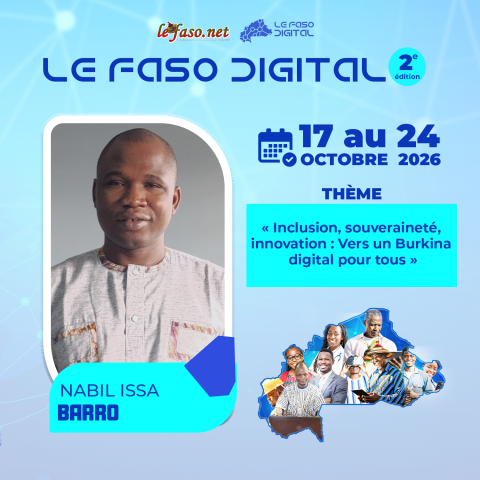
Burkina Faso digital — As Le Faso Digital 2026 approaches, Nabil Issa Barro, a software engineer and data scientist, is recognized for his significant contributions to Burkina Faso’s digital sector. Barro, who previously served as a webmaster and graphic designer for Éditions Lefaso, has navigated the evolving landscape of digital technologies over the past decade, moving from website development to complex data analysis and digital health solutions.
His career trajectory mirrors the broader transformations within Burkina Faso’s digital sphere. Barro’s academic journey began in Banfora, where he earned a baccalauréat in 2008. He then pursued an engineering degree in computer science in Bobo-Dioulasso, graduating in 2011. He furthered his education in Ouagadougou, obtaining a master’s degree in applied IT methods for business management in 2012 and a DESS in IT and communication technologies in 2014. His commitment to staying at the forefront of technological advancements is underscored by his return to university in 2025 to complete a Master II in Data Sciences, focusing on the critical fields of data and artificial intelligence.
From Webmaster to Public Service Engineer
Barro’s early professional experience at Éditions Lefaso from August 2012 involved managing the technical aspects of the media outlet, including website design, content updates, image processing, and server administration. He also contributed as a trainer in website design and image editing. This role provided him with a foundational understanding of the digital infrastructure required for online presence.
In February 2014, Barro transitioned to the public sector, joining the Ministry of Digital Transition and later the National Agency for the Promotion of Information and Communication Technologies (ANPTIC). During his nearly eight-year tenure, his responsibilities expanded significantly. He moved beyond website management to developing applications and electronic services for public administration, focusing on software engineering, database management, and data visualization.
Between 2017 and 2018, he led the department responsible for deploying applications and e-services, overseeing testing, infrastructure integration, maintenance, and user training. This period marked his deep involvement in the operational backbone of the state’s digital services.
Harnessing Public Data for Decision-Making
A key aspect of Barro’s work at ANPTIC involved managing public data. He played a role in establishing and maintaining databases designed to collect, centralize, and disseminate public information. His efforts focused on structuring data collection, processing, analysis, and visualization, as well as developing tools for long-term data management. This work enabled platforms that not only produced but also consumed data, transforming raw information into usable resources for various stakeholders, including government bodies, partners, citizens, researchers, and journalists.
This evolution signifies a shift from simply publishing information online to structuring, cross-referencing, and visualizing public data, making it more accessible and actionable. Geographic information systems (GIS) became a significant focus from 2019 onwards, with Barro leading a team to develop a platform for managing georeferenced infrastructure data for the Directorate-General for Territorial Development.