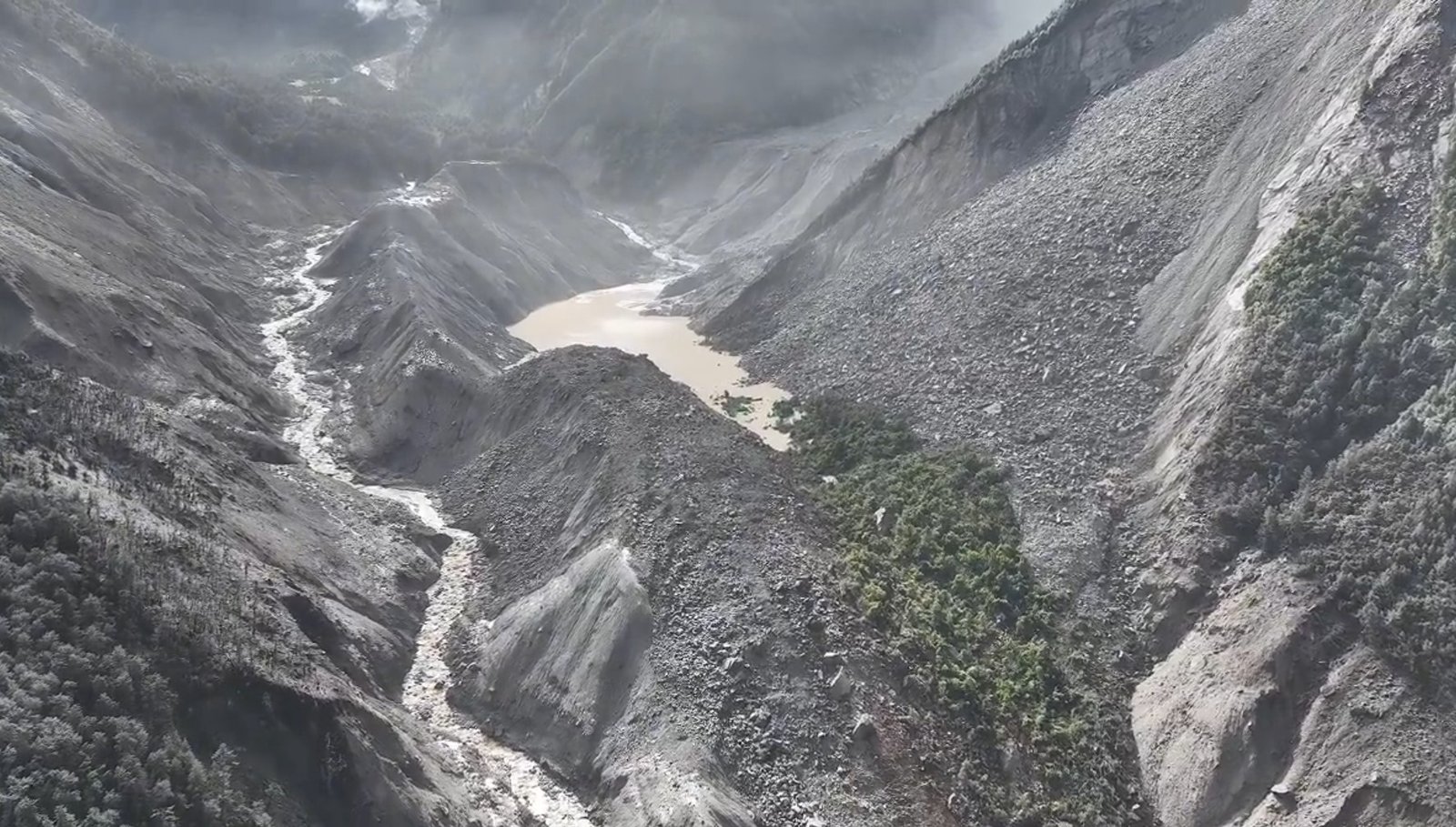
China-Nepal border avalanche — Authorities in China and Nepal are closely monitoring a newly formed lake near the border between the two countries, following a massive landslide in the Gyirong region of Tibet. The lake, which emerged after a major mudslide, is now seen as a serious threat due to the possibility that its natural dam could collapse, potentially triggering further avalanches and flooding.
Aerial footage released on August 27, 2026, by the official newspaper of the Communist Party of China shows the lake at the confluence of the Chhochen Khola and Purepu Tsangpo rivers, close to the Nepalese border. According to Chinese officials, the reservoir had already accumulated around two million cubic meters of water—roughly equivalent to 800 Olympic-sized swimming pools—by Thursday morning. Forecasts suggest that an additional three million cubic meters could flow into the area over the next three days, raising concerns about the stability of the natural barrier holding back the water.
Chinese teams are using drones and monitoring equipment to map the affected region and assess the condition of the dam. The Chinese government has stated it is conducting continuous surveillance and running simulations to predict the potential impact if the barrier fails. The main concern is that a sudden release of water and debris could devastate areas already hit by previous floods and landslides, which were triggered by the collapse of a glacier in Tibet earlier this year.
Officials from both China and Nepal report that more than 300 people have died and approximately 1,500 remain missing following the recent disasters. These figures are still provisional, as differences in data collection and verification methods, along with communication challenges in the affected zones, have led to discrepancies between agencies.
The situation remains precarious as authorities race to prevent further tragedy in a region already struggling with the aftermath of severe natural disasters.