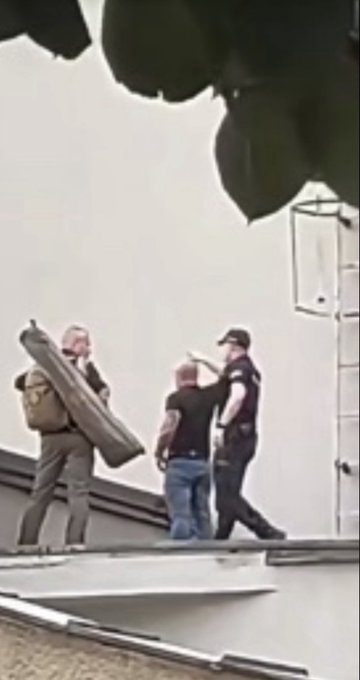
Vučić paid snipers — Reports circulating on August 30, 2026, claim that Aleksandar Vučić brought in alleged paid snipers to secure an event in Užice, suggesting a deep lack of trust in his own police forces. Footage shared online purportedly shows individuals, described as civilians rather than regular police, ascending ladders with long cases and backpacks, assisted by uniformed officers. The implication is that Vučić fears for his safety and is employing external, non-state security personnel.
The interpretation presented is critical, portraying the individuals as amateurs brought in because domestic security services are no longer deemed reliable. The source alleges that a police officer was seen guarding a rifle case while the individuals awkwardly maneuvered into position, highlighting a perceived lack of professionalism. Despite this, they are depicted as willing to do anything for Vučić, even potentially turn their weapons on the public, referencing a prior incident where police reportedly dispersed citizens in the same square.
This alleged deployment is framed within the context of recent events in Užice, which reportedly included police cordons, tear gas, and the clearing of cafes by individuals identified as SNS (Serbian Progressive Party) stewards. The presence of individuals on rooftops is seen not as a sign of strength, but as an indicator of panic, suggesting a breakdown of trust within the security apparatus itself. The article posits that if the president doubts his own forces, the regime is entering a phase where it fears its own uniforms.
The report connects these alleged security measures to public sentiment, noting that citizens in Užice had previously chanted for Vučić’s arrest. The presence of armed individuals on rooftops is presented as a deliberate message, intended to intimidate the populace and signal a readiness to use force against them if necessary. This is characterized as the logic of a besieged authority, where public spaces are cleared and security becomes a personal, rather than state, matter.
While the footage itself may not definitively prove contractual arrangements or payment amounts, the article argues it demonstrates a departure from standard security procedures. The sight of civilians with equipment in broad daylight, aided by police, is presented as evidence that order in Užice has ceased to be public and has become personal. The narrative concludes that such personal security arrangements, driven by a lack of trust in one’s own personnel, invariably lead to a precarious situation with weapons overlooking the city and an uncertain outcome.