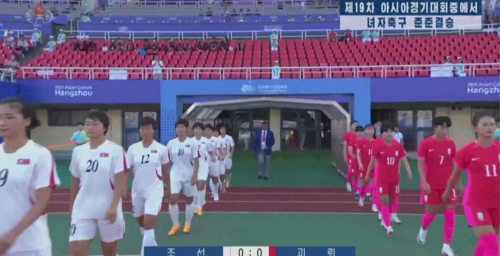
Anticipation Builds for Historic Soccer Clash at Asian Games
In a significant sporting event, North Korea’s women’s soccer team is poised to face off against their South Korean counterparts at the Asian Games this September. This highly anticipated match follows a recent encounter in which the North Korean team emerged victorious, defeating the South Korean side before going on to secure the title at the Asian Football Confederation (AFC) Women’s Champions League. The upcoming clash is not just a game; it symbolizes the ongoing athletic rivalry between two nations that have a fraught history.
The Aichi-Nagoya Asian Games Organizing Committee confirmed the match on Thursday, emphasizing its importance in the broader context of inter-Korean relations. The Korean Peninsula remains technically at war, as the Korean War concluded in 1953 without a formal peace treaty. This long-standing division has led to a complex relationship where sports often serve as a rare avenue for engagement. The previous match between the two teams not only highlighted the skills of the North Korean players but also provided a fleeting moment of connection amid political tensions.
Soccer has long been a platform for both North and South Korea to showcase their national pride. The upcoming match is expected to attract considerable attention from fans and media, with many viewing it as more than just a sporting event. The historical backdrop of the rivalry adds an intriguing layer to the competition, as past encounters have sometimes sparked diplomatic discussions, albeit briefly. The Korean teams’ performances on the field can resonate with their respective populations, reflecting national sentiments and aspirations.
The match will take place in Aichi, Japan, where the Asian Games are being hosted. This location is significant, as it provides a neutral ground for both teams, away from the intense political atmosphere that characterizes interactions on the Korean Peninsula. As the two teams gear up for this high-stakes encounter, the implications of their performance extend beyond the field. A victory for either side could influence public perception and possibly affect the delicate relations between North and South Korea.
The historical context of soccer in the region is rich, with the sport often serving as a reflection of national identity and unity. In the past, matches between the two Koreas have drawn large crowds and generated intense media coverage, serving as a reminder of the shared culture that exists despite the political divide. The upcoming match is likely to evoke strong emotions from fans, with many hoping for a display of sportsmanship that transcends the longstanding animosities.
As the date of the match approaches, both teams are likely to face immense pressure, not only to perform well but also to represent their nations on an international stage. The North Korean team, having recently triumphed in the AFC Women’s Champions League, will enter the match with confidence, while the South Korean players will be eager to reclaim their honor after the previous defeat. The stakes are high, and the outcome of this match could have ramifications that reach far beyond the soccer pitch, potentially impacting the narrative surrounding inter-Korean relations.
With the world watching, this match at the Asian Games will be a critical moment in the sporting calendar and a poignant reminder of the complexities that exist between North and South Korea. As athletes prepare to compete, the hope remains that, if only for a brief moment, the spirit of competition can foster a sense of unity and understanding between two nations that have long been divided.