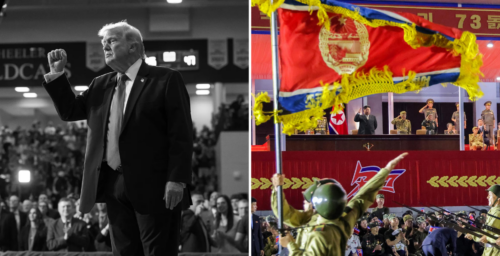
Trump’s Warning on Ideological Resurgence Echoes Korean War Legacy
On July 27, 2026, U.S. President Donald Trump commemorated the anniversary of the Korean War Armistice Agreement with a pointed warning about what he perceives as a resurgence of communist ideology. In a statement issued from the White House, Trump articulated concerns that the same ideological currents that led to North Korea’s invasion of South Korea in June 1950 are now attempting to infiltrate Western societies. This declaration coincided with National Korean War Veterans Armistice Day, a day set aside to honor the sacrifices made by those who fought in the conflict.
In his remarks, Trump underscored the historical significance of the Korean War, which lasted from 1950 to 1953 and resulted in the division of the Korean Peninsula into the communist North and the democratic South. He reflected on the bravery and sacrifices of American soldiers who participated in the war, emphasizing the need to remain vigilant against ideological threats. His statement served as both a tribute to veterans and a call to action against what he views as the encroachment of leftist movements and socialist policies in the United States and Europe.
The president’s assertion that communism is gaining ground in the West resonates within a broader political discourse that has intensified in recent years. Many U.S. politicians and commentators have expressed concerns over the rising popularity of socialist ideas, particularly in the wake of various social movements advocating for increased government intervention in economic matters. This ideological shift, as Trump suggests, poses a challenge to traditional democratic values and free-market principles that have long been the foundation of Western societies.
Trump’s comments are particularly poignant given the current geopolitical climate, characterized by heightened tensions between the United States and North Korea. Under the leadership of Kim Jong-un, North Korea has continued to develop its nuclear capabilities and conduct missile tests, actions that have drawn condemnation from Washington and its allies in the region. This environment of uncertainty and threat has further fueled the narrative that communism, once considered a relic of the past, is now a pressing concern that demands renewed attention and response.
As the anniversary of the Korean War serves as a historical reminder of the ideological battles that have shaped global politics, Trump’s warning seeks to galvanize support for a more assertive U.S. foreign policy. He argues that vigilance is necessary not only against state actors like North Korea but also against non-state actors that promote ideologies he deems detrimental to Western values. This framing aligns with a growing sentiment among certain political factions that view socialism and communism as existential threats to American democracy.
The president’s remarks have sparked a range of reactions across the political spectrum. Supporters of Trump often echo his concerns, citing examples of what they perceive as socialist policies gaining traction in American political discourse. Critics, however, argue that such warnings may be exaggerated, suggesting that the fear of communism has been used historically as a political tool to stifle dissent and justify aggressive foreign policy measures.
As discussions surrounding the role of government, economic policy, and social justice reforms continue to evolve, Trump’s invocation of the Korean War and its ideological implications serves as a rallying point for those advocating for a return to traditional values. The ongoing debate over the influence of leftist movements in the West may very well shape the political landscape in the years to come, as both supporters and opponents of these ideologies seek to define what it means to uphold democratic principles in an increasingly polarized world.